

Blog
EPA Section 609 Certification: What It Is, Who Needs It, and How to Get Certified

EPA Section 609 Certification: What It Is, Who Needs It, and How to Get Certified
If you work with automotive air conditioning systems, you may have heard the term EPA Section 609 certification. But what exactly does it mean, who needs it, and why is it important?
Whether you are an experienced automotive technician, a new HVAC professional, a shop owner, or simply someone interested in learning more about vehicle air conditioning, understanding Section 609 can help you work safely, legally, and responsibly with refrigerants.
In this guide, we’ll explain EPA Section 609 certification in simple terms, including who needs it, what the certification covers, how the certification process works, and how it differs from EPA Section 608 certification.
What Is EPA Section 609 Certification?
EPA Section 609 certification is a certification required under Section 609 of the U.S. Clean Air Act for technicians who service or repair motor vehicle air conditioning (MVAC) systems for payment or other consideration.
The U.S. Environmental Protection Agency (EPA) requires technicians who perform covered MVAC service work for compensation to receive training and certification through an EPA-approved Section 609 technician training and certification program.
The purpose of these requirements is to reduce the release of refrigerants into the atmosphere and encourage technicians to use proper refrigerant recovery and servicing practices.
In simple terms:
If you are paid to service certain vehicle air conditioning systems, Section 609 certification may be required before you perform that work.
What Is MVAC?
MVAC stands for Motor Vehicle Air Conditioning.
It generally refers to air conditioning systems used to cool the passenger compartment of vehicles such as:
Cars
Pickup trucks
Vans
Buses
Certain heavy-duty vehicles
Some other mobile equipment covered by EPA requirements
These systems use refrigerants to transfer heat and produce cool air inside the vehicle.
When an MVAC system is repaired, recharged, or otherwise serviced, refrigerant can potentially be released into the atmosphere if the work is not performed correctly.
That is one reason the EPA has established requirements for refrigerant handling and technician certification.
Why Is EPA Section 609 Certification Important?
Vehicle air conditioning systems contain refrigerants that can have environmental impacts if they are improperly released.
Historically, automotive air conditioners commonly used refrigerants such as CFC-12 (R-12). Older refrigerants can contribute to ozone depletion, while many refrigerants and their substitutes can also have significant global warming impacts.
Modern vehicle air conditioning systems use newer refrigerants, but proper handling is still important.
EPA requirements are designed to help prevent unnecessary refrigerant emissions and promote responsible servicing practices.
Section 609 certification helps technicians understand:
Refrigerant handling
Recovery procedures
Proper servicing practices
Refrigerant regulations
Approved equipment
Environmental impacts
Safety considerations
Applicable EPA requirements
Who Needs Section 609 Certification?
The EPA states that a person who repairs or services an MVAC system for consideration, such as payment or bartering, must be trained and certified under Section 609 through an EPA-approved program.
This can include professionals who perform automotive air conditioning service as part of their job.
For example, Section 609 may be relevant to:
Automotive service technicians
Auto repair technicians
Automotive HVAC technicians
Vehicle air conditioning specialists
Auto repair shop employees
Technicians working on fleet vehicles
Professionals servicing MVAC-like systems covered by the rules
If you are unsure whether a particular type of work or vehicle falls under Section 609, it is important to review the applicable EPA requirements or consult an appropriate compliance professional.
What Does a Section 609 Technician Learn?
Section 609 training focuses on the proper servicing of motor vehicle air conditioning systems and the responsible handling of refrigerants.
Training may cover subjects such as:
1. Refrigerant Handling
Technicians learn why refrigerants should not be intentionally released and how proper handling procedures help reduce emissions.
2. Refrigerant Recovery
Recovery is an important part of MVAC servicing. Refrigerant should be properly recovered using appropriate equipment instead of intentionally venting it into the atmosphere.
3. Service Equipment
Technicians need to understand the proper use of refrigerant handling equipment.
EPA requires covered technicians to use refrigerant handling equipment that has been certified by EPA or by an independent standards testing organization approved by EPA.
4. Refrigerant Safety
Different refrigerants can have different safety characteristics. Technicians should understand the appropriate precautions before working on a system.
5. Environmental Protection
Training helps technicians understand the relationship between refrigerants, ozone protection, greenhouse gas emissions, and environmental regulations.
6. EPA Regulations
Technicians learn the rules that apply to servicing MVAC systems, including requirements related to refrigerant recovery and handling.
Is It Illegal to Vent Refrigerant?
Intentional release, commonly called venting, of regulated refrigerants during the servicing of MVAC systems is generally prohibited under EPA requirements.
The goal is to prevent refrigerants from unnecessarily entering the atmosphere.
Instead of releasing refrigerant, technicians should use appropriate recovery procedures and equipment.
The EPA specifically states that refrigerant must be properly recovered and recycled or reclaimed before it can be reused, including when the refrigerant is being returned to the same vehicle from which it was removed.
This makes proper refrigerant recovery one of the most important practices for responsible MVAC servicing.
What Is Refrigerant Recovery?
Refrigerant recovery is the process of removing refrigerant from an air conditioning system and storing it in an appropriate container rather than releasing it into the atmosphere.
A technician may need to recover refrigerant before performing certain repairs or servicing procedures.
Proper recovery helps:
Reduce refrigerant emissions
Protect the environment
Allow refrigerant to be recycled or reclaimed
Support compliance with EPA requirements
Improve safe servicing practices
Technicians should always use appropriate recovery equipment and follow the applicable manufacturer’s and EPA requirements.
What Refrigerants Are Used in Vehicle Air Conditioning?
Vehicle air conditioning refrigerants have changed significantly over the years.
Older vehicles may contain refrigerants such as R-12, while many vehicles have used HFC-134a (R-134a). Newer vehicles may use alternative refrigerants, including HFO-1234yf, depending on the vehicle and system.
The refrigerant used in a vehicle should always be identified before servicing.
A technician should never assume that every vehicle uses the same refrigerant.
Using the wrong refrigerant can create safety, performance, equipment, and compliance problems.
The EPA also regulates acceptable refrigerants and their use in MVAC applications.
What About Newer Vehicle Refrigerants?
Automotive air conditioning technology continues to change.
The EPA’s current regulations include requirements affecting refrigerants used in newly manufactured vehicles. For example, under the EPA’s Technology Transitions regulations, new light-duty passenger vehicles are subject to a refrigerant global warming potential limit of 150 for affected model years and compliance dates.
This means automotive technicians should stay informed about changing refrigerant technologies and servicing requirements.
As vehicle technology evolves, technicians may encounter different refrigerants and system designs throughout their careers.
EPA Section 609 vs. EPA Section 608
One of the most common questions is:
“Is EPA 609 the same as EPA 608?”
No.
Although both certifications involve refrigerants, they address different types of equipment.
EPA Section 609
Section 609 focuses primarily on Motor Vehicle Air Conditioning (MVAC) systems.
It is particularly relevant to technicians who service vehicle air conditioning systems for compensation.
EPA Section 608
Section 608 focuses on technicians who service or dispose of certain stationary refrigeration and air conditioning equipment.
Section 608 has certification categories such as:
Type I
Type II
Type III
Universal
The EPA describes these as certifications for different types of stationary refrigeration and air conditioning equipment.
Therefore, EPA 609 should not be confused with the Type I, Type II, Type III, and Universal certification structure used under Section 608.
If your work involves both automotive and stationary refrigeration equipment, you may need to understand the requirements that apply to each type of work.
Does EPA 609 Certification Expire?
Technicians should understand the certification requirements applicable to their work and keep their certification documentation available.
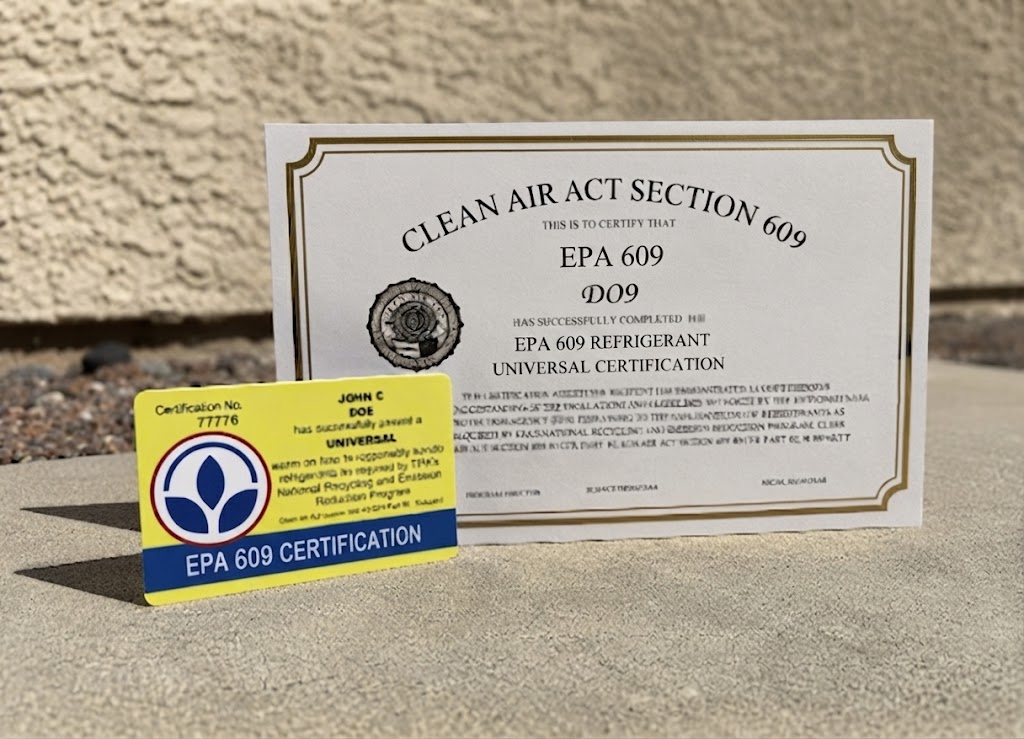
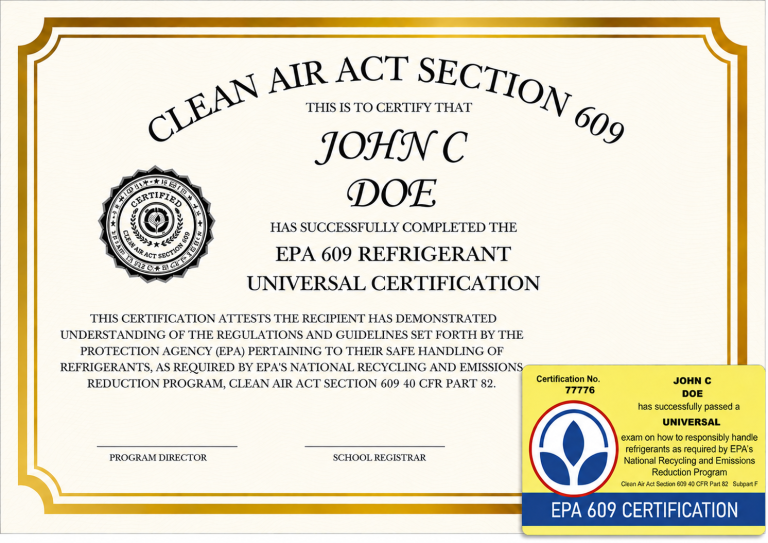
EPA-approved Section 609 programs issue proof of certification to individuals who complete the required training and testing. EPA states that this proof can include a certificate, wallet-sized card, or display card with a unique certification number.
Because requirements and program procedures can change, technicians should always verify current information with their certification provider and the EPA.
How Do You Get EPA Section 609 Certified?
Getting certified generally involves completing training and passing a certification test through an EPA-approved Section 609 technician training and certification program.
A typical process looks like this:
Step 1: Learn the Requirements
Start by understanding what Section 609 covers and whether it applies to the work you perform.
Step 2: Complete Approved Training
Enroll in training through an EPA-approved Section 609 program.
Training should cover the relevant regulations, refrigerant handling procedures, equipment requirements, safety, and environmental considerations.
Step 3: Study the Material
Review your course materials and practice questions.
Focus on understanding the concepts rather than simply memorizing answers.
Step 4: Take the Certification Test
The EPA requires technicians to demonstrate their knowledge by passing a test through an EPA-approved certification program.
Step 5: Receive Your Certification
After successfully completing the required process, the certification program provides proof of certification.
Keep your certification information in a safe place because you may need it when working for an employer, servicing vehicles, or purchasing certain refrigerants.
Can You Get EPA 609 Certification Online?
Many technicians prefer online training because it allows them to study from home, work, or another convenient location.
Online learning can be useful for professionals who:
Have full-time jobs
Want flexible study hours
Need to prepare for certification quickly
Prefer self-paced learning
Want digital study materials
Need access from a computer or other device
However, it is important to distinguish between online training and the actual certification requirements.
The EPA maintains a list of approved Section 609 technician training and certification programs. Anyone seeking certification should verify that the program they choose is appropriately approved.
How Long Does EPA 609 Certification Take?
The amount of time required depends on the training program, your previous experience, and how much time you can dedicate to studying.
Someone who already works with automotive air conditioning systems may be familiar with many of the concepts, while a beginner may need more time to understand refrigerants, recovery procedures, regulations, and equipment.
The best approach is to study the material carefully and make sure you understand the responsibilities associated with working with MVAC refrigerants.
What Equipment Do Technicians Need?
Proper equipment is an important part of compliant MVAC servicing.
Depending on the work being performed, technicians may use equipment such as:
Refrigerant recovery equipment
Recovery/recycling equipment
Service hoses
Gauges
Appropriate refrigerant containers
Leak detection equipment
Other manufacturer-specified service tools
EPA requirements state that applicable refrigerant handling equipment must be certified by EPA or an independent standards testing organization approved by EPA.
Technicians should also follow the vehicle manufacturer’s service procedures and the instructions supplied with the equipment.
Why Should Automotive Technicians Get Certified?
For automotive professionals, Section 609 certification is more than just another credential.
It demonstrates knowledge of responsible refrigerant handling and helps technicians understand the regulations that apply to MVAC servicing.
Certification can be valuable because it can:
Help support regulatory compliance
Improve knowledge of refrigerant handling
Promote environmentally responsible servicing
Increase confidence when working on MVAC systems
Help technicians meet workplace requirements
Support professional development
For shop owners, having properly trained and certified technicians can also help establish better refrigerant handling practices within the workplace.
Final Thoughts
EPA Section 609 certification plays an important role in responsible motor vehicle air conditioning service.
For automotive technicians, understanding Section 609 means more than simply passing a test. It means learning how refrigerants affect the environment, how to recover and handle refrigerants correctly, how to use appropriate equipment, and how to follow the rules that apply to MVAC servicing.
If you work with vehicle air conditioning systems for compensation, getting properly trained and certified through an EPA-approved Section 609 program can help you perform your work with greater knowledge and confidence.
Ready to learn more about EPA Section 609 certification? Explore the training and certification resources available through EPA609.com and take the next step toward becoming a knowledgeable, responsible MVAC technician.
Important: EPA regulations and certification requirements can change. Always verify current requirements with the U.S. Environmental Protection Agency and an EPA-approved certification program before performing regulated work.
Sources & Further Reading
U.S. Environmental Protection Agency — Section 609 Technician Training and Certification Programs
U.S. Environmental Protection Agency — Regulatory Requirements for MVAC System Servicing
U.S. Environmental Protection Agency — Technician and Shop Owner Resources
U.S. Environmental Protection Agency — Motor Vehicle Air Conditioning (MVAC) System Servicing